Showing posts with label Astronomy. Show all posts

Aug 20, 2017

The Great American Eclipse

Crossposted from Reflections Journal.


The last total eclipse of the sun to be visible in the United States was in 1979. Above is a little nostalgia viewing on the eclipse that was. Walter Cronkite's reassuring voice is sorely missed. But it was a calmer time, a time when all we had to worry about was the Cold War and the looming threat of a nuclear holocaust. They seem like halcyon days to me now.

For Americans, this eclipse may be more relevant than any we've seen in nearly a hundred years, because this one will cross the entire continental United States. Astrologers are predicting massive change and upheaval. In particular, there are warning signs for the Trump presidency and for the man himself. In the interest of full disclosure, I am not an astrologer, so I cannot vouch for their accuracy.

According to astrologer Donna Woodwell, in the most comprehensive analysis I've seen, the eclipse means "massive changes for the U.S."

First, the location from which an eclipse is visible indicates the areas of the world ripe for changes in society, cultures or leadership.

. . .

Of course, the “Great American Eclipse” puts the U.S. in the crosshairs of change.

It’s the first total solar eclipse to be visible coast-to-coast across the U.S. in nearly 100 years; the last time was in June 1918. Another pivotal year in U.S. history, 1918 saw a dramatic increase in the size of the U.S. government and armed forces, as the nation sent the first major deployment of troops overseas in the nation’s history.

The Aug. 21 eclipse is also the first total solar eclipse to be visible in totality only from the U.S. since the nation was founded in 1776.

Sep 27, 2015

Blood Moon, Super Moon

 photo bloodtreemoon_zpsapap9pzg.jpg


Tonight we will be getting quite a light show, as a rare astronomical event unfolds.

This coming Sunday night (September 27), observers around the world are set to be in for a treat as two celestial events combine. In a rare occurrence, the Moon will reach its closest point to Earth (known as a supermoon) at the same time as it undergoes an eclipse, the first such alignment since 1982 – and the last until 2033.

During the event, when the Sun will be directly behind us in respect to the Moon, the lunar surface will appear a deep red color. Lunar eclipses are fairly common, with 16 occurring this century already, but only five supermoon eclipses have taken place since 1900.

It will be best seen at every longitude from the U.S. to Europe, encompassing Central and South America, the U.K. and Africa. Observers in western Asia and Alaska will have a lesser view. Check out this map at timeanddate.com to see the best locations.

Mar 20, 2015

Triple Whammy

 photo triplewhammy_zpswnvrledx.png


Today is the Vernal Equinox. It is also a supermoon. And a total solar eclipse. It's a triple whammy of celestial events, capping off a week of turbulent space weather and challenging transits. If you're feeling overwhelmed and enervated you're not alone. I'm hearing widespread reports of disrupted sleep cycles, intense dream activity, and erratic energy levels. I am not exempt from any of the above.

According to some skywatchers, this eclipse signals the apocalypse.

The connection between Friday’s eclipse and the end of the world comes partly from the “Blood Moon Prophecy”. That refers to the theory that a tetrad — four consecutive lunar eclipses, with six full moons between them — is a sign that the world is coming to an end.

Those that believe in the prophecy see it partly borne out by the Book of Joel, which says that “the sun will turn into darkness, and the moon into blood, before the great and terrible day of the Lord comes”. That has been connected to the phenomenon of the blood moon — the phenomenon where the moon turns copper red as it passes under the Earth’s shadow.

March’s solar eclipse have been connected by some to the series of lunar ones that are seen as harbingers of the end times. This solar eclipse sits in the middle of the tetrad, and is seen as another signal that signs are appearing in the sky.

Apr 14, 2014

Into the Darkness


Late tonight we will be treated to a total lunar eclipse. Slate has a detailed writeup on where and how to view it.

Do you live in North America, South America, Australia, or eastern Asia? Then you get to see a lunar eclipse on the night of April 14/15! And while North America is the best place to watch—we’ll get to see the whole event—the real action doesn’t begin until 05:58 UTC on the 15th, which is just before 02:00 EDT, so it’s a bit late. You might just want to stay up for it, though.

It will also be broadcast live by the Griffith Observatory.

But this is just the attention getter for a series of celestial alignments that astrologers are claiming is one for the books. This Easter will bring with it a collective crucifixion as a Grand Cross in the Cardinal signs.

Aug 7, 2013

The Flipping Sun


The sun is getting ready to reverse its polarity, which will put us at the midway point of solar maximum. It has been an unusually quiescent solar maximum, which has gone some way to calming concerns about a potential Carrington Event. Of course it only takes one. A report that we just barely avoided one a couple of weeks ago has been the subject of some dispute. (If this link redirects you, find August 2, 2013)

A little before the one minute mark, there's an image of the Wilcox Solar Observatory at Stanford. I can't help noticing that it strongly resembles a pyramid with a sun at the apex.


May 9, 2013

HuffPo to Broadcast Eclipse


Next best thing to being there... Well, not really, but it'll have to do.

While some Aussies will be able to witness the annual "ring of fire" eclipse first-hand, the rest of the world won't be able to get a glimpse of the spectacular event -- at least, not in the sky.

So how can you watch the eclipse? We'll be running a live feed right here on HuffPost Science starting at 5:30 pm Eastern on Thursday, May 9.

SLOOH, a private company that controls robotic space cameras, often broadcasts such events through a real-time feed in true color -- we'll have their feed, along with a slideshow where readers can submit photos of the event and their setup for watching it.

Named for the ring shape created by the moon blocking part of the sun's light, the 'ring of fire' or 'annular' solar eclipse will be visible in certain parts of Australia and the Southern Pacific Ocean.

Comments on this entry are closed, on this blog. If you wish to comment, please find this and all newer blog entries crossposted on Celestial Reflections.

Feb 24, 2013

An Astronomer's Paean to a Solar Flare


In what some might call "sun worship," astronomer Phil Plait waxes rhapsodic on how the sun giveth and the sun taketh away.

That barely constrained violence can be difficult to square with the grace and elegance of the motion. The Sun can damage our civilization, yet we also depend on it for our existence. But there you go: The Universe is full of such dichotomies.

It is harsh, inhospitable, destructive, and capable of crushing indifference.

It is pleasing, habitable, serene, and capable of life-altering beauty.

I wouldn’t have it any other way.

The video is a time-lapse movie of a solar flare raining in beautiful arcs onto the sun's surface. It is hard not to appreciate the beauty of the thing as we offer thanks to Sol Invictus for not taking out our entire power grid and plunging us back into a pre-technological era.

So what causes the fiery phenomenon? Coronal rain occurs when plasma in the solar atmosphere cools and gets attracted by magnetic field lines on the Sun's surface. As NASA’s Goddard Space Flight Center explained in a written statement, "This plasma acts as a tracer, helping scientists watch the dance of magnetic fields on the sun, outlining the fields as it slowly falls back to the solar surface."

. . .

This eruption was special, NASA said, because it combined three out of three possible events: a solar flare, an ejection of solar material (called a coronal mass ejection) and coronal rain.

Comments on this entry are closed, on this blog. If you wish to comment, please find this and all newer blog entries crossposted on Celestial Reflections.

Nov 14, 2012

Total Eclipse: Views from the Land Down Under


Yesterday was the last total solar eclipse we'll see until 2015. Aussies had a great view. The rest of us, not so much. But thanks to the wonders of technology, we can look at some pretty pictures. Is it as good as being there? No. But it's a little reminder of just how small this planet has become.

A total solar eclipse will occur on Tuesday afternoon, when the moon passes briefly between the Earth and the Sun, obscuring the solar rays and creating a 95-mile-wide shadow over parts of the Southern Hemisphere.

Only people who are lucky enough to be in northern Australia or somehow find themselves in the Indian or Pacific Oceans along the path of the eclipse -- where it will actually be early Wednesday morning -- will be able to see the celestial event.

But don't worry if you're not there in the flesh -- broadcasts of the eclipse will be available on several live streams and The Huffington Post is live blogging the event, bringing updates from astronomers and other experts, some of whom are on the ground in Australia.


Comments on this entry are closed, on this blog. If you wish to comment, please find this and all newer blog entries crossposted on Celestial Reflections.

Aug 30, 2012

Once in a Very Blue Moon


Tomorrow will be our last chance to see a blue moon until July of 2015. Of course, blue moons are no bluer than any other full moon -- only rarer. They're anomalous calendrical events that come about because our lunar cycle doesn't quite jibe with our 12 month, solar calendar. By our current definition, blue moons are really just like other full moons except that they happen to fall as a second full moon in a month. That makes them kind of neat, so people write songs about them.

What makes this blue moon particularly special is that it is also the day that Neil Armstrong will be laid to rest.

There's a rare `blue moon' on Friday, a fitting wink to Neil Armstrong by the cosmic calendar.

That's the day of a private service for Armstrong, the first man to walk on the moon, who died last Saturday in Ohio at age 82.


Comments on this entry are closed, on this blog. If you wish to comment, please find this and all newer blog entries crossposted on Celestial Reflections.

Aug 6, 2012

Rover Curiosity Takes Pictures on Mars


History was made today as Curiosity landed on Mars. The rover has begun returning photos from the red planet.

Thanks to a remarkable combination of engineering and mathematics, a NASA satellite in orbit around Mars was able to capture a picture of the split second when Curiosity fell from the skies to its successful landing on the surface of the red planet.

"We have ended one phase of the mission much to our enjoyment," mission manager Mike Watkins said. "But another part has just begun."

And in a splendid second act, the rover beamed back its first images from the surface of the planet, including a shot Monday night of Mars' Mount Sharp looming in the distance, the object of Curiosity's own programmed curiosity.

The rover's shadow can be seen in the foreground, with dunes in the distance. And beyond rises the highest peak of Mount Sharp, at a height of about 3.4 miles taller than Mount Whitney in California. The Curiosity team hopes to drive the rover to the mountain to investigate its lower layers, which scientists think hold clues to past environmental change.


Comments on this entry are closed, on this blog. If you wish to comment, please find this and all newer blog entries crossposted on Celestial Reflections.

Jul 8, 2012

Solar Fireworks, Solar Fears


The sun has had an active Fourth of July week, setting off a number of fireworks of its own. Sunspot AR1515 let lose with an X class solar flare on Friday, after a week of powerful ejections. An M class flare, earlier in the week caused a minor radio blackout. This one does not appear to be aimed directly at Earth but may cause further radio disruption.

The most powerful solar flare of the summer erupted from the sun on Friday, marking the latest in a string of strong storms this week from our home star.

The sun storm occurred just after 7 p.m. ET and registered as a class X1.1 solar flare — one of the strongest types of solar flares possible, according to the U.S. Space Weather Prediction Center, run by NOAA and the National Weather Service.

The huge solar flare erupted from the giant sunspot AR1515, which has already fired off several other powerful storms this week. Space weather scientists were closely watching the sunspot for possible X-class flares.

. . .

In a new alert announcing the X-class solar flare, SWPC officials said the sun storm could a "wide-area blackout" in the high-frequency radio communications.


It looks like this one should miss us completely but it's a powerful reminder of the damage one of these things can do if it's aimed straight at the planet. From SpaceWeather:

The explosion hurled a CME into space. According to this movie from the Solar and Heliospheric Observatory, the cloud appears to be heading south and away from Earth. Update: Analysts at the Goddard Space Weather Lab say the CME will miss eveything. Their forecast track shows the cloud not hitting any spacecraft or planets.

The storm on sunspot AR1515 is ongoing and more CMEs are likely.

If you wish to understand why NASA is watching the sun so closely these days, it's because of a genuine threat to a world as technologically advanced -- and technologically dependent -- as ours has become. A Carrington Event of the magnitude of the one for which they are named could hurl us back to an early 1800s lifestyle... or worse.

Solar activity peaks every 11 years sending waves of charged particles careening toward the earth at speeds over 1,000 miles an hour. Much of this energy is absorbed by the upper atmosphere, but some of it gets through and hits the surface of the earth -- fortunately at levels too low to cause direct damage to humans. It can, however, interfere with the high power transmission lines which crisscross the U.S. When these lines get overloaded, they can knock out and sometimes destroy the transformers whose task it is to step down the voltage which passes through them. This is what led to the blackout in Quebec.

But scientists know that vastly larger and more destructive solar storms than this are not just possible, but inevitable. The last recorded Solar Superstorm called the "Carrington Event" occurred over a period of nine days in 1859. It is is believed to have been caused by an explosion on the sun equivalent in force to a billion hydrogen bombs. Auroras were seen as far south as the Caribbean, and telegraph networks failed across the Northern Hemisphere, in some cases even catching fire.

Nobody knows when another storm of this size will envelop our planet, but a recent estimate published in the International Journal of Research and Applications says that there is a one in eight chance of this happening within the next decade. If it does, electrical grids throughout the world will not just fail, but be destroyed. NASA warns that such an event would cause "an avalanche of blackouts carried across continents [that] ... could last for weeks to months."

Some experts worry that it could actually take years to rebuild our grids and networks. So, yeah, the sun merits watching.


Comments on this entry are closed, on this blog. If you wish to comment, please find this and all newer blog entries crossposted on Celestial Reflections.

Jun 6, 2012

Views of Venus


Well, we missed it. Nothing but clouds and rain here. But thanks to the magic of technology, voilà ici!

More viewing options and information can be found here.


Comments on this entry are closed, on this blog. If you wish to comment, please find this and all newer blog entries crossposted on Celestial Reflections.

Jun 5, 2012

Today: Venus Transit 2012


It won't be visible from Earth again until 2117. Today the planet Venus will transit the sun and astute sky watchers in the Northern Hemisphere will see it as a tiny black dot moving across the sun's surface.

Transits of Venus happen in pairs eight years apart, with more than a century between cycles. During the pass, Venus appears as a small, dark round spot moving across the face of the sun, like a bug on a dinner plate.

. . .

Tuesday's transit, which bookends a 2004-2012 pair, begins at 6:09pm EDT (2209 GMT) and lasts for six hours and 40 minutes. Times can vary by seven minutes depending on the location of the observer.

Skywatchers on seven continents, including Antarctica, will be able to see all or part of the Venus transit, which should only be observed with telescopes outfitted with solar filters to protect the eyes.

MSNBC has detailed information on how the sun can be viewed safely.


Comments on this entry are closed, on this blog. If you wish to comment, please find this and all newer blog entries crossposted on Celestial Reflections.

May 20, 2012

Eclipse 2012: Random Views


Tokyo, Japan


Shibuya, Japan


Reno, NV


Albuquerque, NM


Lago Vista, TX


Courtenay Comox Valley, BC, Canada


Antelope, CA


Redondo Beach, CA


Comments on this entry are closed, on this blog. If you wish to comment, please find this and all newer blog entries crossposted on Celestial Reflections.

Ring of Fire: Eclipse 2012


Later today an annular solar eclipse will be visible in parts of the US for the first time in nearly 18 years. The most complete view will be on the West Coast.

The western United States and eastern Asia will be treated this weekend to a rare solar spectacle when the moon slides across the sun, creating a “ring of fire.”

. . .

The solar spectacle will first be seen in eastern Asia around dawn Monday, local time. Weather permitting, millions of early risers in southern China, northern Taiwan and southeast Japan will be able to catch the ring eclipse.

Then, the late day sun (on Sunday in the U.S.) will transform into a glowing ring in southwest Oregon, Northern California, central Nevada, southern Utah, northern Arizona and New Mexico and finally the Texas Panhandle.

The Huffington Post has more on what, how, and where, including a handy chart of viewing times and locations.


As the moon revolves aroundEarth, it passes between our planet and the sun once every 29.5 days. Most of the time,the moon zips either above or below the sun, and no eclipse occurs. [Video: How to View the May 20 Solar Eclipse]

But if the moon is close to one of its orbitalnodes— the points where the orbits of Earth and the moon cross — the moon will pass directly in front of the sun and block its light. If the moon is also close to apogee,the point that marks its farthest distance from the Earth, it will not completely cover the sun, and we get an annular eclipse.

"Annular" comes from the Latin word annulus (ring) and refers to the fact that a ring of sun shines all around the moon.

They've also posted interactive maps and other viewing options. They're all kindsa into it at HuffPo. Good for them!

NASA has a list of when and where the can be seen, even in those locations outside the path of annularity. Check out the map below and click the yellow pins to see when the eclipse will be visible in that location, and for even more locations, click over to NASA's comprehensive list. (Hint: Here's a UTC time conversion table.)

. . .

If you're east of the Mississippi River, don't worry -- the Slooh Space Camera is broadcasting the event live, using telescope feeds from Japan, California, Arizona and New Mexico. Slooh's live feed begins at 5:30 p.m. EDT on Sunday.

And remember, kids. Never look directly at the sun. Not even during an eclipse.


Comments on this entry are closed, on this blog. If you wish to comment, please find this and all newer blog entries crossposted on Celestial Reflections.

Apr 28, 2012

Robert Schoch and William Henry on the Sun


Excellent discussion this week on William Henry's Revelations about the sun cycle and just how bad it could get. Robert Schoch is the geologist who researched the weather patterning on the Sphinx and back-dated its construction to some time before recorded history. His work has been extensively cited by Graham Hancock, Robert Bauval, and John Anthony West, who sought out his expertise to evaluate the claims of R.A. Schwaller de Lubicz. Schoch has since turned his attention to Gobekli Tepe, the oldest known temple which was fairly recently discovered in Turkey. (See here)

In this interview he discusses geological, archaeological, and mythological evidence of a civilization ending solar catastrophe in the ancient past. He describes an event that would have dwarfed the 1859 Carrington Event that saw northern lights as far south as Hawaii and set telegraph stations on fire. He is not alone in positing that this may be what the Mayan calendar warns. It also bears mentioning, I think, that one of the Time Monks' most consistent predictions is the meme "sun disease."

Schoch and Henry also discuss the possibility that the weird noise phenomenon, discussed here and here, may be associated with the unusual radiation coming from the the sun. Schoch explains the interrelationship between electromagnetic radiation and sound. We already know that the radiation bursts from the sun can be translated into sound -- like all energy, really -- so it's an interesting theory. There is a very metallic ring to what was recorded here. So this is one of the most substantive suggestions I've heard yet on this issue. 

Schoch is a sober researcher and a scholar so this is a very even-handed discussion. His book on the topic is here and more information can be found at RobertSchoch.com.


Comments on this entry are closed, on this blog. If you wish to comment, please find this and all newer blog entries crossposted on Celestial Reflections.

Sep 2, 2011

Esoterica


Has King Arthur's round table been found in Scotland?

The King's Knot, a geometrical earthwork in the former royal gardens below Stirling Castle, has been shrouded in mystery for hundreds of years.

Though the Knot as it appears today dates from the 1620s, its flat-topped central mound is thought to be much older.

Writers going back more than six centuries have linked the landmark to the legend of King Arthur.

. . .

"The finds show that the present mound was created on an older site and throws new light on a tradition that King Arthur's Round Table was located in this vicinity."

We may have been a seafarin' people since before we were even human.

A team of researchers that included an N.C. State University geologist found evidence that our ancestors were crossing open water at least 130,000 years ago. That's more than 100,000 years earlier than scientists had previously thought.

Their evidence is based on stone tools from the island of Crete. Because Crete has been an island for eons, any prehistoric people who left tools behind would have had to cross open water to get there.

The tools the team found are so old that they predate the human species, said Thomas Strasser, an archaeologist from Providence College who led the team. Instead of being made by our species, Homo sapiens, the tools were made by our ancestors, Homo erectus.

Will we find the God Particle in time for Christmas?

The hunt for the Higgs particle is well ahead of schedule, say researchers at the Large Hadron Collider (LHC).

Earlier this year they said they would either discover the Higgs or confirm it does not exist by the end of 2012.

Now, because the machine is working so well, an LHC spokesman, Professor Guido Tonelli, has told BBC News that the search could be completed much sooner.

The Higgs Boson is the particle that in the physics "Standard Model" allows other particles to have mass.

Discovery or elimination of the particle is one of the LHC's major objectives; and it could come as early as Christmas 2011.

Edgar Cayce, look out! The sleeping artist is here. A nocturnal painter believes he may be receiving artistic guidance from the spirit world.

Being an artist is so easy, Lee Hadwin can do it in his sleep, but when he is awake, the 37-year-old, who got a D in art at school, cannot paint or draw to save his life.

He discovered his nocturnal talent aged four, when he began to sleepwalk and draw on his mother’s furniture.

. . .

Since then, he has produced almost 200 sleep-pictures, selling them to collectors such as illusionist Derren Brown, with one piece fetching a six-figure sum. He does not know why he can draw only in his sleep but believes it may be spirits communicating from the other side.

Buy at Art.com
Buy From Art.com

Gardens in spaaaaaaaaace!

Astronauts on the first manned missions to Mars could tend “kitchen gardens” of salad and vegetables onboard spaceships, scientists claim.

Experts say the crops would not only give crews healthy food to eat during the long journey to the red planet, but would also improve the atmosphere onboard by producing oxygen and removing carbon dioxide.

In addition, the plants suggested as suitable by a NASA scientist would require minimal tending and not take up much room on spacecraft.

Bad pizza in spaaaaaaaaace!

Domino's pizza has announced plans to conquer the final frontier by opening the first pizza restaurant on the Moon.

Domino's Japanese arm has proposed a branch on Earth's nearest galactic neighbour is the latest escalation in a pizza publicity war.

Rival chain Pizza Hut set the bar high in 2001 by delivering a pizza to astronauts orbiting the Earth in the International Space Station, but Domino's fought back last year in a series of events to mark the 25th anniversary of its arrival in Japan.

Diamonds are forever.

A newly discovered alien planet that formed from a dead star is a real diamond in the rough.

The super-high pressure of the planet, which orbits a rapidly pulsing neutron star, has likely caused the carbon within it to crystallize into an actual diamond, a new study suggests.

The composition of the planet, which is about five times the size of Earth, is not its only outstanding feature. [Illustration of the diamond alien planet]

The planet's parent star is a special kind of flashing star known as a millisecond pulsar, a rapidly rotating neutron star formed from a supernova. The entire system, which is only the second of its kind ever discovered, is located about 4,000 light-years from Earth in the constellation of Serpens (The Snake).

Chimera alert! Spider goats developed for the military.

Researchers genetically engineered goats to produce milk which is packed with the same protein as silk spiders.

Once this is milked out it can be spun out and weaved into a material that is ten times stronger than steel.

The fabric can then be blended with human skin to make what the scientists hope will be tough enough to stop even a bullet.

Dutch researcher Jalila Essaidi said the ‘spidersilk’ project was called ’2.6g 329m/s’ after the weight and the velocity of a .22 calibre long rifle bullet.

An elephant never forgets. And elephants are smarter than we know.

Kandula, a seven year old Asian elephant living in Washington D.C.’s National Zoo, has proven that elephants are as smart as those that spend a lot of time around them have believed. In an experiment carried out by researchers at the zoo, the little elephant figured out all on his own, without resorting to trial and error, how to go get a cube to use as a footstool to help him reach some food that was just out of reach. The research team, led by Preston Foerder of the City University of New York, has published the results of their study on PLoS ONE.

Other animals (besides humans) such as chimpanzees and dolphins have demonstrated in various ways that they are capable of dreaming up solutions to problems in their head and then carrying them out. Called “aha” moments by researchers, such thinking, a form of insight, is one of the hallmarks of higher intelligence. Most people who have ever worked with elephants will attest to the fact that they are indeed intelligent creatures; though no one (at least in the research community) had ever witnessed an elephant using insight to solve a problem. This has perplexed scientists for several years, and has caused them to study the seeming paradox. It appears now that the team working with Kandula has seen it in action, that previous research had been attacking the problem from the wrong angle.

Buy at Art.com
Buy From Art.com


More news items can always be found in the Esoterica feed in the right-hand column here.


Comments on this entry are closed, on this blog. If you wish to comment, please find this and all newer blog entries crossposted on Celestial Reflections.
Jul 1, 2011

Kissing the Sun


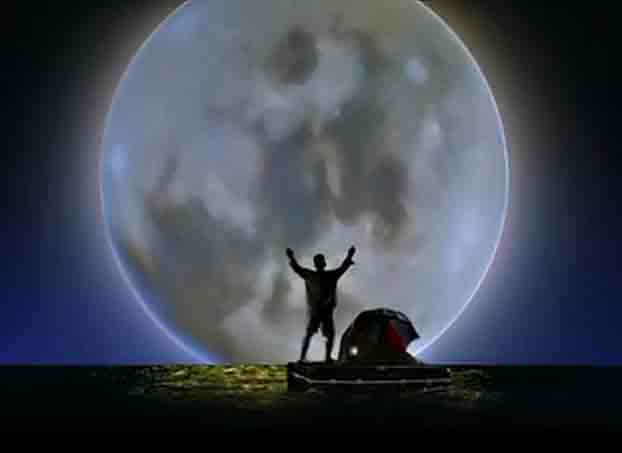
With today's partial solar eclipse, we will complete another of what Lauren Gorgo calls sandwich cycles; two solar eclipses on either side of a lunar eclipse. And I agree with Gorgo that the lunar eclipse was a doozy.

How are you faring?

We did come up for a quick breath of air after integrating that noxious lunar eclipse, but only for a hot second before the solstice energy waves started to pull us under again.

This lunar eclipse was a doozy for many…in some cases it successfully cracked open core blocks and forced us to take a solid look at our foundations before we begin to build upon them. If your foundation was slightly damaged, most likely you spent the last 7 days repairing it. If the damage was severe or irreparable, you may have been suddenly forced to begin again…to dig up the existing foundation and lay an entirely new one. If you are one who is experiencing the latter, no worries...this is not a race. Everything is always exactly as it should be.

For all of us, the lunar eclipse provided a massive opportunity to release some deeeeeeep feelings of lack/unworthiness…we were given the chance to coddle those remaining loveless parts which, unfortunately meant revisiting some dark places in our past so that we could illuminate and reclaim those aspects of ourselves that we unknowingly left behind.

No argument. It's been intense and I've been awash in memory, nostalgia, and icky, toxic goo.  It has definitely been a time to face hard truths about ourselves and undertake the difficult work of loving them back into wholeness. And, at the same time, there's been a feeling of tremendous movement, shifting, and expansion. I've had the feeling for weeks that thing are about to kick into high gear and that many of the changes will be unexpected and surprising. It would seem Karen Bishop concurs. I got this in my email last night.

The energies have really kicked in of late and are creating massive amounts of movement within. Symptoms? You may feel like crying for no apparent reason, have a racing heart, shortness of breath, difficulty sleeping, and feel short-tempered. You may feel like you are losing it, feel acutely overwhelmed, or even as though no one is remotely making any sense.

Hectic, hectic, hectic, and busy, busy, busy are results of this fast moving energy which pushes most of everything in its path along at a very steady and rapid pace. We absolutely cannot keep up with the rapid creations now, and hence, may continually feel overloaded. Add to this the pushing of the energies themselves, and head pressure, neck stiffness, and overall PRESSURE all around are common results.

People we encounter may cut us off abruptly with a need to move away (not a very high level response with connection and unity the desired reality! --- creating even more confusion and sad hearts!), or continue to ramble on about their personal situations with a near hysteria at the core, if even so subtly (can't blame them...this energy is intense!)

Guilty as charged! I know I have been both weepy and bitchy -- not an attractive combination.

So, here's some information on the "stealth eclipse" of today, which will complete, at least, that cycle of strangeness.

If you miss the partial eclipse of the sun on Friday (July 1), don't feel bad; everyone else on the planet will likely miss it, too. But a touch of skywatching trivia makes it a rare event.

Friday's solar eclipse will occur over an extremely remote part of the world — an uninhabited region in the southern Atlantic Ocean just off the coast of Antarctica. You could even call it a "stealth" eclipse since it will probably only be seen by a few penguins and leopard seals.

. . .

On June 1, a more impressive partial solar eclipse occurred over Earth's northern polar region, stunning skywatchers across Europe and Asia. Then, on June 15, a total lunar eclipse (the first of two in 2011) occurred, with the moon turning a blood-red hue for skywatchers across the Eastern Hemisphere.

And now we have a third eclipse, and the second partial eclipse of the sun. This trio of eclipses is possible because of the mechanics of the moon's phases, according to SPACE.com's skywatching columnist Joe Rao. [Infographic: How Moon Phases Work]


Comments on this entry are closed, on this blog. If you wish to comment, please find this and all newer blog entries crossposted on Celestial Reflections.

Mar 21, 2011

It's Only a Supermoon


This past Saturday many people witnessed what's called a supermoon. The moon looks bigger because it's closer to the planet. Here's a technical explanation from NASA.

"The last full Moon so big and close to Earth occurred in March of 1993," says Geoff Chester of the US Naval Observatory in Washington DC. "I'd say it's worth a look."

Full Moons vary in size because of the oval shape of the Moon's orbit. It is an ellipse with one side (perigee) about 50,000 km closer to Earth than the other (apogee): diagram. Nearby perigee moons are about 14% bigger and 30% brighter than lesser moons that occur on the apogee side of the Moon's orbit.

"The full Moon of March 19th occurs less than one hour away from perigee--a near-perfect coincidence1 that happens only 18 years or so," adds Chester.

I didn't get outside to see the event, myself. I had a very full weekend. And therein lies a tale.

Jan 16, 2011

Esoterica


The Crab Nebula has surprised astronomers by shooting off mysterious flares.

One of the most well-known celestial objects still has some tricks up its sleeve, according to a new discovery of surprising gamma-ray flares coming from the famous Crab Nebula.

The Crab, long-considered such a steady celestial light that it was used to calibrate other sources, has now had three flare-ups where it brightened significantly in the gamma-ray range for a few days, astronomers report.

"Our belief of a stable Crab got smashed completely — now we have to think again," said Marco Tavani, an astronomer at the INAF-IASF (Istituto Nazionale di Astrofisica-Istituto di Astrofisica Spaziale e Fisica Cosmica) in Rome.

And solar flares could threaten the 2012 Olympics. Of course they could threaten far more than that.

Weather experts told the Commons science and technology committee: 'Extreme space weather events typically occur at the solar maximum, which itself follows a roughly 11-year cycle.

'The next solar maximum is expected around 2012-13 — potentially coinciding with the London Olympic Games.'

It is only the most extreme solar storms that cause chaos, and Olympic organisers do not believe there is a 'significant risk' of major disruption.

NASA has found the first evidence of a rocky planet orbiting a sun outside of our solar system.

NASA's Kepler mission confirmed the discovery of its first rocky planet, named Kepler-10b. Measuring 1.4 times the size of Earth, it is the smallest planet ever discovered outside our solar system.

The discovery of this so-called exoplanet is based on more than eight months of data collected by the spacecraft from May 2009 to early January 2010.

"All of Kepler's best capabilities have converged to yield the first solid evidence of a rocky planet orbiting a star other than our sun," said Natalie Batalha, Kepler's deputy science team lead at NASA's Ames Research Center in Moffett Field, Calif., and primary author of a paper on the discovery accepted by the Astrophysical Journal. "The Kepler team made a commitment in 2010 about finding the telltale signatures of small planets in the data, and it's beginning to pay off."

And an amateur astronomer has discovered four planets from the comfort of his own home.

Peter Jalowiczor, 45, has never owned a telescope but still managed to provide scientists with enough information to establish the existence of four gaseous orbs outside the solar system.

The gas worker from Rotherham, South Yorkshire, has been officially named by the University of California's Lick-Carnegie Planet Search Team as the co-discoverer of planets HD31253b, HD218566b, HD177830c and HD99492c.

. . .

An overwhelmed Mr Jalowiczor said: 'I've always been interested in astronomy and I have two science degrees but to be one of the officially recognised finders of these planets is just... I get lost for words.'

Using just two home computers, he spent night after night analysing thousands of space measurements released by astronomers at the Santa Cruz-based university in 2005.

There may be a galaxy right near our own, invisible because it's almost entirely made up of dark matter.

An entire galaxy may be lurking, unseen, just outside our own, scientists announced Thursday.

The invisibility of "Galaxy X"—as the purported body has been dubbed—may be due less to its apparent status as a dwarf galaxy than to its murky location and its overwhelming amount of dark matter, astronomer Sukanya Chakrabarti speculates.

Detectable only by the effects of its gravitational pull, dark matter is an invisible material that scientists think makes up more than 80 percent of the mass in the universe.

And antimatter is apparently turning up in thunderstorms.

Scientists using NASA's Fermi Gamma-ray Space Telescope have detected beams of antimatter produced above thunderstorms on Earth, a phenomenon never seen before.

Scientists think the antimatter particles were formed inside thunderstorms in a terrestrial gamma-ray flash (TGF) associated with lightning. It is estimated that about 500 TGFs occur daily worldwide, but most go undetected.

"These signals are the first direct evidence that thunderstorms make antimatter particle beams," said Michael Briggs, a member of Fermi's Gamma-ray Burst Monitor (GBM) team at the University of Alabama in Huntsville (UAH). He presented the findings Monday, during a news briefing at the American Astronomical Society meeting in Seattle.

Astronomers claim to have found the "missing link" between the big bang and the formation of the universe.

For years scientists have known nothing about the "dark ages" of space – a period between the Big Bang 13.7 billion years ago and the creation of the first stars.

But Cambridge University researchers have now captured light emitted from a massive black hole to peer into this unknown portion of the history of the universe.

They discovered remnants of the first stars and evidence of the aftermath of an exploding star, which was 25 times larger than the sun.

Meanwhile, Pope Benedict has proclaimed a link between the big bang and God.

God's mind was behind complex scientific theories such as the Big Bang, and Christians should reject the idea that the universe came into being by accident, Pope Benedict said on Thursday.

"The universe is not the result of chance, as some would want to make us believe," Benedict said on the day Christians mark the Epiphany, the day the Bible says the three kings reached the site where Jesus was born by following a star.

"Contemplating it (the universe) we are invited to read something profound into it: the wisdom of the creator, the inexhaustible creativity of God," he said in a sermon to some 10,000 people in St Peter's Basilica on the feast day.

Pope Benedict has also proclaimed that the late Pope John Paul II performed a miracle as the sex abuse enabling former pope wends his way towards beatification.

Pope Benedict XVI has formally approved a miracle attributed to his late predecessor, paving the way to John Paul II's beatification on 1 May.

. . .

The Vatican credits him with the miraculous cure of a nun said to have had Parkinson's Disease.

Church officials believe that the Polish pope, who himself suffered from the condition, interceded for the miraculous cure of Sister Marie Simon-Pierre, a Frenchwoman in her late forties.

Catholic clergy in Spain are up in arms about a naked limbs -- naked everything, really -- in a sacrilicious calendar.

A Catholic youth group has shocked its religious superiors in Mallorca by producing a calendar that features a nude version of the passion of Christ.

The wrath of the bishop of Mallorca has fallen on the Davallament youth group from the Spanish island's town of Sant Joan after they decided to make the stripped-down version of the Easter week story to raise funds.

The calendar features a semi-naked trio of young men raising the cross on which Jesus will be crucified and a Last Supper whose protagonists wear only crotch-hugging underwear. In other shots the protagonists are entirely naked, covering their genitalia with plumed roman helmets (above).

This other act of remarkable, spiritually guided artistry remains largely overlooked.

It's the sheer size of the structure that first strikes you. Almost 40 metres (131ft) tall, its spires and giant dome tower over the surrounding apartment blocks in this Madrid suburb.

That's not unusual for a Spanish church. But this one is being built by an elderly man, almost single-handedly, out of junk.

Justo Gallego - or Don Justo, as he's known - embarked on his epic endeavour almost half a century ago.

Now 85 years old, he still has a huge amount to do.

Archaeologists have turned up the first evidence of both Stone Age residents on the Isle of Crete and ancient sea travel.

Archaeologists on the island of Crete have discovered what may be evidence of one of the world's first sea voyages by human ancestors, the Greek Culture Ministry said Monday. A ministry statement said experts from Greece and the U.S. have found rough axes and other tools thought to be between 130,000 and 700,000 years old close to shelters on the island's south coast.

Crete has been separated from the mainland for about five million years, so whoever made the tools must have traveled there by sea (a distance of at least 40 miles). That would upset the current view that human ancestors migrated to Europe from Africa by land alone.

"The results of the survey not only provide evidence of sea voyages in the Mediterranean tens of thousands of years earlier than we were aware of so far, but also change our understanding of early hominids' cognitive abilities," the ministry statement said.

The incredible, shrinking brain:

Man's brain has been gradually shrinking over the last 20,000 years, according to a new report.

This decrease in size follows two million years during which the human cranium steadily grew in size, and it's happened all over the world, to both sexes and every race.

'Over the past 20,000 years, the average volume of the human male brain has decreased from 1,500 cubic centimetres to 1,350 cubic centimetres, losing a chunk the size of a tennis ball,' Kathleen McAuliffe writes in Discover magazine.

A thirteenth astrological sign has been announced messing up everybody's charts. I've never been gladder that I'm not an astrologer.

The star doctors say Earth is currently in a different spot in relation to the Sun, and its equatorial alignment has changed from 3,000 years ago when the study of astrology began -- back when 12 zodiac signs were assigned to 12 different periods of the year.

Those signs you were born into are different now because the Earth's wobble on its axis has created a one-month bump in the alignment of the stars, according to Kunkle.

"Because of this change of tilt, the Earth is really over here in effect and Sun is in a different constellation than it was 3,000 years ago."

More esoteric news items can always be found in the Headlines feed in the right-hand column here.


Comments on this entry are closed, on this blog. If you wish to comment, please find this and all newer blog entries crossposted on Celestial Reflections.